| 1981 | 1982 | 1985 | 1986 | 1987 | 1990 | 1991 | 1994 | 1995 | 1996 | 1997 | 2000 | 2001 | 2002 | 2003 | 2004 | 2007 |

| Day7: 26 August, Alkajaure - Njåtjosvagge, 19 km | |
|
The area with osier is not large. We make a detour to avoid it. After a kilometer are we at the brook Alep Sarvesjåkkå. We follow it upstream towards south. The feeder stream Rissajåkkå is today a rill. It has the origin from Lulep Rissajaure, a small lake a few kilometers away. On Tjågnårisskaite do Sarvesjåkkå divide, one arm from Sarvesvagge, the other from south (Tjågnårisjåkkå). Here we have our lunch. The same do a gang of grazing reindeers. The weather, up to now rather sunny, change. Clouds fall down, Sarvesvagge in the east disappear in haze. An ice cold wind blow from the north. We give up our idea of walking Jeknavagge (the small valley at Ryggåsberget and parallell to upper Njåtjosvagge). It must be poor visibility up there (1400m). There is not much water in Tjågnårisjåkkå either, one easily walk on stones to the other side. Our path leads us now to Njåtjosvagge. We walk up the slope to the two small lakes, Tjågnåris- and Skiejakjauratj, north of the watershed. From the crest down to Njåtjosvagge is a magnificient view of the valley, with its three lakes. Njåtjosvagge is one of the most grand vallyes in Sarek. The height difference from the lake to the surrounding mountains is about one thousand meters. While we stand there do the sun for a short moment shine on us through a crack in the clouds. Long enough to allow a picture of the scenery. The north side of the valley is extremely easy to walk, except for a few places with many and large stones. The rain has made it slippery and slushy. It is five degrees, the cold wind continue to push us from behind. If one choose the south side, then one is on the wrong side to reach Kvikkjokk via Pårte. Njåtjosjåkkå further south is normally not easy to cross. After the outlet from the last lake, where the valley widen, is a rather large waterfall. The view of southern Njåtjosvagge is not so bad. Below us and beside the waterfall, is a grassy space, perfect for the night. We slide down on the snow that covers the slope, down to our booked place. |
Tjågnårisskaite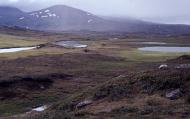 Njåtjosvagge 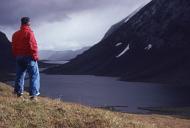 |