| 1981 | 1982 | 1985 | 1986 | 1987 | 1990 | 1991 | 1994 | 1995 | 1996 | 1997 | 2000 | 2001 | 2002 | 2003 | 2004 | 2007 |

2004
Picture gallery
Photo album
Slide show
| Day9: 18 August, Staloluokta - Kvikkjokk, 2 km | |
|
It is only me who is alert in the morning. Half past six do I sit alone in the kitchen and is eating breakfast. Gradually do more people wake up. It is good weather for an helicopter flight, almost no wind and the clouds are high up. The helicopter is late, while waiting do we chat with two norwegians. We test their binocular with autofocus, it is very practically. Finally can we hear the sound of an helicopter. In total are we five passengers. We fly close to Gierggevárre, the pilot explain that they must avoid the trail else will people complain about the noise. The lake Festajávrre arrive and disappear, we pass Tarraluoppal, and further into what I believe is the valley with the lake Buojdes. We end up in Tjuoldavágge. It is a fascinating flight. Upper Tjuoldavágge is dominated by birchforest, which gradually is replaced with coniferous forestas we proceed. Many animals are said to live in the valley, the pilot point out an elk. Eveybody lean to the side he points to. I would really like to visit the valley. It is difficult to identify the hills, but the stone mounds must be Tjårok and Ruovddevárre? Änok is a fantastic view, with meandering river and wetland. We get an impressive view of Kvikkjokk before we land at the helicopter port a few kilometers outside the village. There are two hangars and an office, where we pay for the trip: 750SEK per person. To Kvikkjokk do one have to walk on the road for a few kilometers. In front of us are the norwegians who will wait for the bus to Jokkmokk in the cafeteria, which is in what we call "the old shop". There was many years ago a rather well equipped shop, now there is a small shop, a naturum, and a restaurant. We continue, pass by the church, and further to the mountain station nearby the fierce Gamajåhkå. After a shower do we have something to eat in "Utkiken". Utkiken is a room in the mountain station where food is served, together with a nice view of Gamajåhkå and the distant Bårdde. On the wall is a photograph of an aircraft, a british bomber from the second worldwar. It crashed on the fjäll Tsahtsa. It was found many years afterwards by some hikers. Three in the crew was killed in the crash. On my own do I give a visit to the beautiful church, built about 1900. I continue to the house that once was the vicarage, which is not as well maintained as the church. In a house nearby is an artgallery, that I unfortunately do not visit. Instead do I look for the traces of the silver mining that took place in the 17th century at Silbbatjåhkkå. It was transported and then worked upon here. The main parts of the remnants are on the other side of Gamajåhkå, which I can not reach. |
Discussion Änokdelta 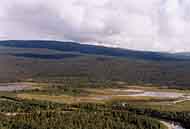 Church in Kvikkjokk 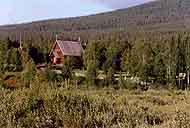 |